You've collected three quotations for the same 12 windows. One says ₹350 per sq.ft. One says ₹520. One says ₹700. All three say "uPVC sliding windows, toughened glass, mesh." All three fabricators told you theirs is the best quality.
So which one is lying?
Possibly none of them. Those three quotes are almost certainly for genuinely different products — the problem is that a uPVC quotation, as usually written in Hyderabad, hides every variable that actually matters. This post opens up all of them. By the end you'll be able to read any quote and know roughly what you're being offered.
We publish our own starting prices — ₹350/sq.ft for sliding, ₹450 for casement — so we have no interest in pretending cheap is always bad or expensive is always better. What we want is for you to know what you're paying for.
The nine things that actually move the price
1. Profile brand: what it tells you, and what it doesn't
The first question every buyer asks. It's worth asking — but it answers less than people assume.
The Indian market has three broad tiers. German-origin systems (VEKA, Deceuninck, Koemmerling) sit at the top on price and consistency. Established Indian-manufactured systems — Prominance, Aparna Venster, Encraft, Fenesta and others — make up the bulk of quality residential work in Hyderabad, and several are engineered specifically for Indian heat, monsoon and UV exposure, which imported cold-climate formulations aren't always. Then there are unbranded or generic extrusions, where you have no published specification, no test certificate and no traceable warranty.
Here's the part that surprises people: the brand on the profile tells you almost nothing about the window you'll receive. The extruder supplies a length of plastic. Everything that determines whether your window works in year ten — the steel inside it, the hardware fitted to it, the accuracy of the welding, the quality of installation — is the fabricator's doing, not the brand's. A careful fabricator using a good Indian system will out-perform a careless one using German profiles, every time.
Mason fabricates primarily with Prominance, alongside one or two other systems depending on the requirement. What we'd tell you to check is the profile marking itself: EN 12608 markings show outer wall thickness class (A, B or C), impact class (Class II is tested from 1.5 m, Class I from 1 m), and weather class — "S" for severe, which is what Indian conditions require, versus "M" for moderate.
Ask: which system, and what is the class and outer wall thickness? If it's a branded system, ask to see the profile marking or test certificate as well.
2. Profile class: the wall thickness of the frame itself
This is the biggest hidden variable, and almost nobody puts it in a quote.
uPVC profiles are classified by the thickness of their walls. Under BIS and European norms, Class A means an outer wall of at least 2.8 mm and inner wall of at least 2.5 mm; Class B means outer wall 2.5 mm and inner wall 2.0 mm. Anything below 2.5 mm on the outer wall falls into Class C.
Half a millimetre sounds trivial. It isn't. A thinner outer wall means less material resisting the daily push-pull of a sliding sash, less depth for screws to hold into, and less room for internal air chambers. Profiles that are too thin bend or sag over time, and that compromises both function and appearance.
Ask every fabricator: what is the profile class and outer wall thickness? A ₹350 quote is very often Class B or C. That's not automatically wrong for a small kitchen window — but you should know that's what you're buying.
3. Steel reinforcement: the part you'll never see
Inside the hollow chambers of a good uPVC profile sits a galvanised steel insert. It carries the structural load, holds the hardware screws, and stops the frame deforming.
Most residential fabricators use 1.2 mm to 1.5 mm reinforcement as a balance of strength and cost. Without reinforcement, profiles droop or bow, resulting in hardware misalignment and seal failure within two to three monsoon seasons. Some suppliers treat reinforcement as optional — something to skip on smaller windows to reduce cost.
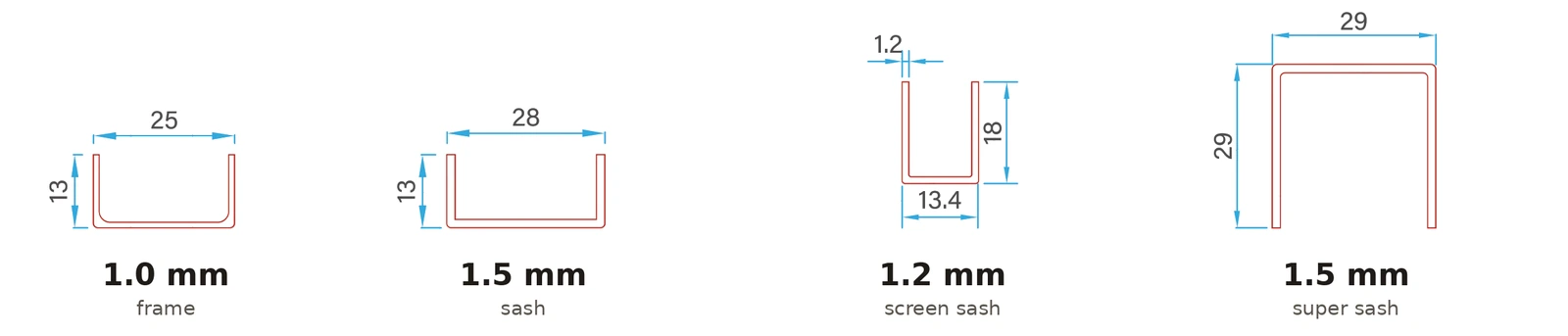
That last sentence is where a large share of the gap between ₹350 and ₹700 lives. Skipping or thinning the steel is invisible at handover, cheap to do, and shows up as a sagging, sticking window three years later.
Two further details worth asking about: the zinc coating (galvanised reinforcement is specified in coatings such as 120, 180 or 275 gsm as per IS 277 — higher matters in coastal Visakhapatnam), and whether reinforcement runs in every structural member or only the outer frame.
4. Hardware — and why sliding and casement aren't priced the same
Hardware is what you physically touch every day, and it fails long before the frame does. Most residential work in Hyderabad runs on Indian-made fittings, and the useful line isn't imported versus domestic — it's named versus unnamed. Recognised Indian makers — DNV, Oben, Pego, Rhylon, Windseal — give you a part someone can identify and replace years from now. A large share of the market runs on unbranded fittings instead, where quality genuinely varies and the label alone won't tell you which end of it you're getting.
But there's a structural point buyers miss: a casement window costs more than a sliding window of the same size largely because of hardware, not profile.
A sliding window needs rollers, a track, interlocks, and a touch or crescent lock. Simple, few moving parts. The roller is the component that decides whether the window still slides smoothly in year eight — cheap rollers are the single most common failure we're called to fix.
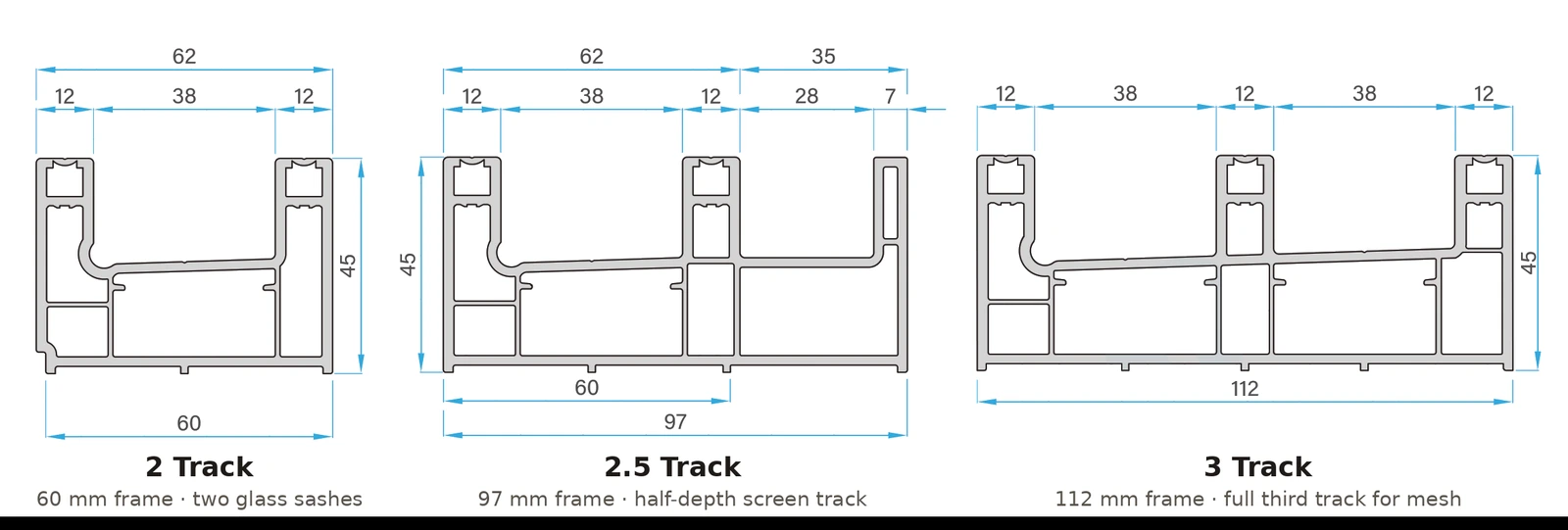
The track sections in the diagram at the top of this post are the same ones that decide something else entirely: whether a mesh sash can be added to the window later, or never.
A casement window needs friction stays or hinges on every openable sash, a multi-point locking system, an espagnolette rod, and a handle per sash. That's several times the hardware content, and it's why our published rate is ₹350/sq.ft for sliding against ₹450 for casement. The profile difference is minor; the hardware and fabrication difference is not.
This matters when you're comparing quotes: a casement quote and a sliding quote are not comparable numbers. If one fabricator quoted you casement and another sliding, you aren't comparing prices — you're comparing products.
Ask: what hardware is fitted, and who replaces a roller or a handle when one fails in year six? A recognised name is genuinely worth paying for if you want a part you can source anywhere. Short of that, the question that matters is who comes back — because hardware is the part of a window most likely to need replacing at some point, whatever is stamped on it.
5. Glass: the largest single material cost
A quote saying "5mm toughened" and one saying "toughened DGU" can differ by ₹200/sq.ft on their own. Options run from plain 4–5mm float, to toughened, to laminated, to double-glazed units. For most Hyderabad homes, single toughened is right for bedrooms and DGU or laminated earns its cost only on main-road-facing rooms where noise is the issue.
The trap is a quote that just says "toughened glass" without thickness. Ask for the number.
6. Gaskets and sealing
The rubber gasket running around your glass and sash is what stops dust and rain. It's also the cheapest place to save money. EPDM is suited to heat and UV exposure; TPE offers flexibility for residential use — and cheap unspecified rubber hardens and cracks in a few Hyderabad summers, at which point the window leaks and whistles.
Corners and joints are the weakest points in any sealing system; if they're not joined properly they let in rainwater and dust. That's a workmanship variable, not a material one — which brings us to the biggest item of all.
7. Window size: why a per-sq.ft rate isn't the whole story
This one is rarely explained, and it's a common reason two honest quotes land at different numbers.
uPVC is bought and consumed by the running foot of profile, not by area. A window's profile consumption follows its perimeter, but it's usually quoted to you by its area — and those two things scale differently.
Take a 2ft × 2ft kitchen window: 4 sq.ft of area, but 8 running feet of frame perimeter — 2 running feet of profile for every square foot. Now take a 6ft × 5ft living room slider: 30 sq.ft of area, 22 running feet of perimeter — well under 1 running foot per square foot. The small window uses roughly twice the profile per square foot, and it also needs the same corner welds, the same hardware set, and the same fabrication and installation time, spread over a fraction of the area.
A published per-sq.ft rate is a useful starting point — ours included — but it's an average. Fabricators account for the difference in a few ways: some apply a minimum billable size for small windows, some hold a flat rate across all sizes, and some cost each window on its actual profile consumption. Any of these can be perfectly fair; what matters is knowing which one you're being quoted on, so you can compare like with like.
At Mason, we work out larger or mixed jobs on actual consumption where it makes a meaningful difference, rather than applying one flat number to every opening in the house. It takes longer to prepare, but the quote reflects what your particular windows use.
Ask: is there a minimum billable size, and is this quote a flat per-sq.ft rate or costed on actual profile consumption? Either answer is fine — but if you're comparing three quotes, make sure you know which basis each one is using.
8. Fabrication and installation quality
Two fabricators can buy the identical profile, steel, hardware and glass, and deliver visibly different windows. Welding temperature and cleanliness at corners, accuracy of cutting, whether the frame is packed and levelled properly in the opening, and how the perimeter is sealed to the wall — none of this appears on any quotation, and all of it determines whether the window leaks.
This is the honest reason a factory-direct fabricator with its own installers can differ in price from a middleman who subcontracts installation to whoever is free that week.
9. Warranty — three different promises from three different people
"25-year warranty" is the most misunderstood line in any window quotation, because there is no such thing as a single window warranty. There are three, and they come from three different parties:
The profile warranty comes from the extruder — the company that made the uPVC. It typically covers discolouration, warping and material defect in the plastic itself, and it's the one that carries the impressive long number. Established brands generally offer 10+ years on profiles.
The hardware warranty is the one to read carefully. Where the fittings carry a manufacturer's name, that maker's own cover applies and passes through to you — ask what it runs to. Where they don't — and much of the residential market doesn't — there is no manufacturer standing behind the part at all, and what you hold is whatever your fabricator gives on it, commonly around a year. Since hardware is what usually fails first, this is the number to ask about directly rather than assume.
The workmanship warranty comes from your fabricator, and it's the only one that covers the things most likely to go wrong: a leaking perimeter seal, a frame that wasn't packed level, a corner weld that opens up, a sash that drops out of alignment. No profile brand will help you with any of these.
Two of those three only exist if there's a name behind the part. With a generic extrusion or unbranded fittings, the extruder's and the manufacturer's warranties aren't short — they're absent, and what you have is whatever your fabricator stands behind, with the workmanship cover doing the heavy lifting. That isn't automatically the worse deal; a fabricator who will actually turn up is worth more than a certificate from a company you will never reach. But it is a different deal, and you should know which one you're being offered.
A 25-year "profile warranty" may not cover hardware, glass, seals, or workmanship separately. So the question isn't "how many years?" — it's "which of the three am I actually getting, and who do I call?" A fabricator who quietly quotes the extruder's 25-year figure as though it were their own is hoping you won't ask.
Ask which of the three actually apply, and what each one covers, before you pay the advance — not after.
So what does each price band actually get you?
Rough, honest guide for the Hyderabad market:
| Spec item | ~₹350–420 / sq.ft | ~₹450–550 / sq.ft | ~₹600–750 / sq.ft |
|---|---|---|---|
| Profile | Class B/C, 2 chambers | Class A/B, 3 chambers | Class A, multi-chamber |
| Steel | Thin, or partial | 1.2–1.5 mm throughout | 1.5 mm+, higher zinc coating |
| Hardware | Unbranded | Named Indian brand | Named Indian brand, heavier grade |
| Glass | 4–5 mm plain/toughened | 5 mm toughened | Toughened DGU or laminated |
| Gasket | Generic rubber | EPDM | EPDM, multi-line sealing |
| Installation | Often subcontracted | Own team | Own team, sealed & tested |
| Realistic life | 7–12 years before issues | 20+ years | 25–30+ years |
None of these is "the wrong answer." A ₹380 window on a rarely-opened store-room opening is a sensible economy. The same window as a 7-foot balcony slider carrying heavy glass on a windy 14th floor is a future problem. Match the spec to the opening, not to the whole house.
Where our own ₹350 sits. Our sliding rate starts at ₹350/sq.ft, and it is not the left-hand column above. At that rate we're working with a generic extrusion rather than a branded system, and it applies to larger openings — which, as section 7 explains, consume less profile per square foot. What doesn't change is the steel: reinforcement is specified to the opening rather than thinned to hit a number, and our own team still installs.
The seven questions to ask every fabricator
Copy these into your next call. The answers — and how comfortable the person is answering — will tell you more than the price will.
- Which profile system, and what is the class and outer wall thickness?
- What thickness of galvanised steel reinforcement, and is it in every member or only the outer frame?
- What hardware is fitted, and who replaces a roller or handle if one fails in a few years?
- What glass thickness and type, exactly?
- Is this quote per sq.ft or on actual profile consumption, and is there a minimum billable size?
- Is installation by your own team or subcontracted?
- What are the profile, hardware and workmanship warranties separately — and who do I call for each?
Any fabricator who won't answer these is telling you something.
Ask us all seven
Send your window sizes and we'll come back with a quote priced opening by opening rather than as one lump sum — and we'll go through the profile, glass and hardware spec with you before you commit to anything.
Where Mason sits, honestly
We publish our starting rates because we'd rather compete on what's inside the window than on who can print the lowest number. We fabricate in our own workshops in Hyderabad and Visakhapatnam — see our full range of uPVC windows in Hyderabad — our own team installs, and we'll tell you when a cheaper spec is genuinely fine for a particular opening — because over-specifying a store-room window helps nobody.
Send us your window sizes on WhatsApp and we'll return an itemised quote — priced opening by opening, not "uPVC windows, lump sum." WhatsApp +91 93479 86085 · Hyderabad +91 93479 86085 · Visakhapatnam +91 93465 86085
Get an itemised quote
Priced opening by opening, not as one lump sum — and we'll talk you through the spec behind the number. Free, no obligation.
Pricing a balcony enclosure rather than individual windows? Our uPVC balcony closing guide applies the same line-by-line thinking to a whole open space.
uPVC quotes, answered
Because "uPVC window" describes a category, not a specification. Profile class and wall thickness, steel reinforcement gauge, hardware brand, glass type and installation quality can each shift the price by ₹50–200 per sq.ft, and most quotations don't state any of them.
Class A profiles have an outer wall of at least 2.8 mm; Class B is 2.5 mm. For main living areas and larger openings, Class A is worth the difference. Smaller, sheltered openings can reasonably use Class B.
Yes. Galvanised steel inside the profile carries the structural load and holds hardware screws. Without it — or with reinforcement that's too thin — frames sag, hardware misaligns and seals fail within a few years. Most residential work uses 1.2–1.5 mm.
No. A lower-spec window can be a sensible choice for small, sheltered, rarely-used openings. The mistake is using the same low spec for large sliders, balcony doors and exposed elevations, where the cost of failure is much higher.
Well-specified and well-installed uPVC windows should run 25–30 years with only cleaning and occasional lubrication. Poorly specified ones typically start showing sagging, sticking or leakage within 7–12 years.
Mostly hardware. A sliding window needs rollers, a track and a simple lock. A casement window needs friction stays or hinges on every sash, multi-point locking, an espagnolette rod and a handle per sash — several times the hardware content, plus more fabrication. That's why our sliding rate starts at ₹350/sq.ft and casement at ₹450.
Because uPVC is consumed by running foot of profile, not by area. A 2×2 ft window uses roughly twice the profile per square foot that a large slider does, and needs the same corner welds, hardware set and installation labour spread over far less area. Fabricators either apply a minimum billable size, absorb it and recover elsewhere, or price on actual consumption.
Only partly. The extruder supplies the plastic; the fabricator decides the steel reinforcement, hardware, welding accuracy and installation — which is what determines whether the window still works in year ten. A careful fabricator using a good Indian system will outperform a careless one using imported profiles.
Profile brand and class, glass type and thickness, gasket material, mesh specification if applicable, installation scope and GST. Reinforcement, hardware and the warranty covering each are worth asking about as well, even where a fabricator doesn't print them on the quote itself.