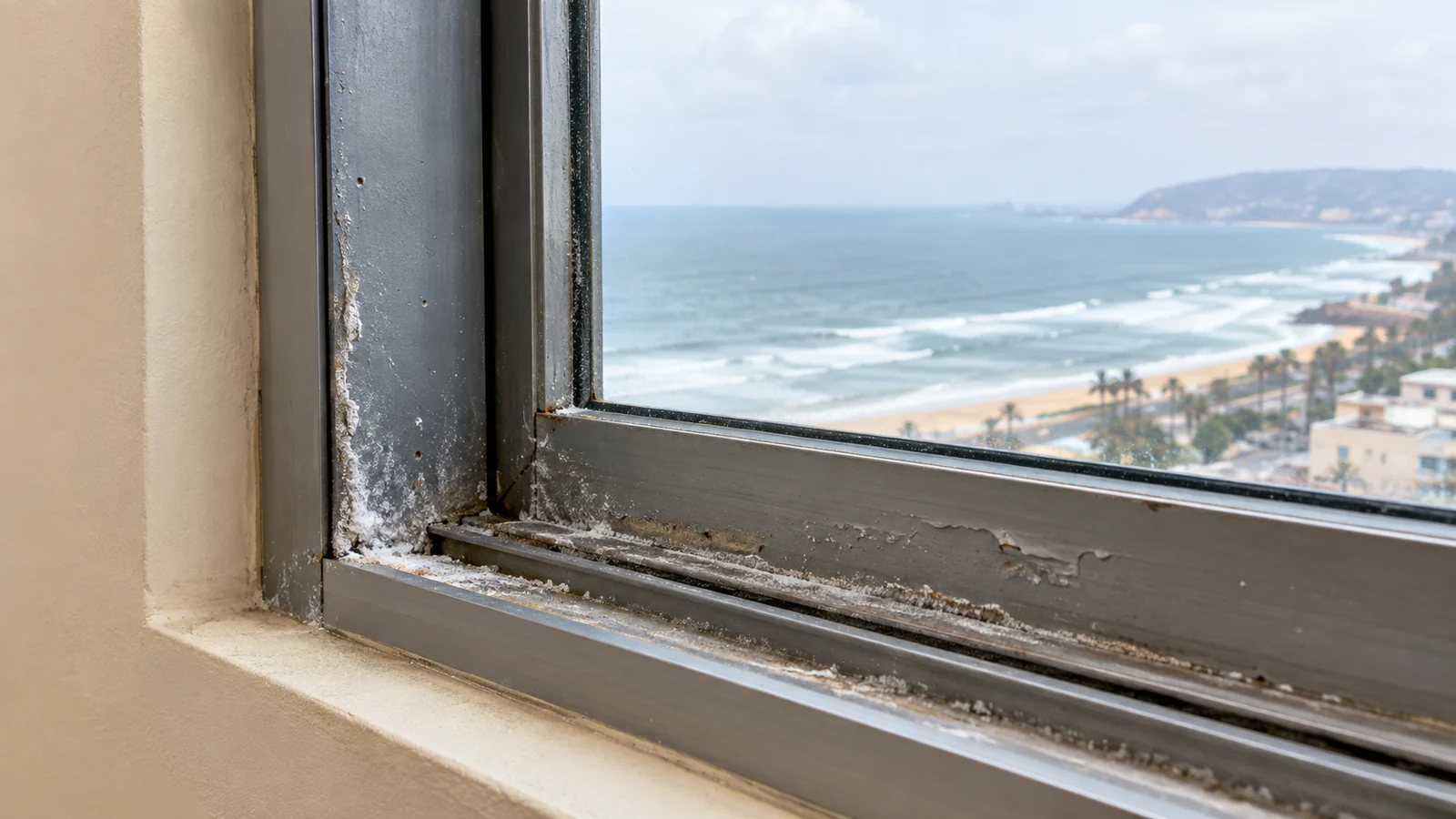
If you live within a few kilometres of the sea in Vizag — along Beach Road, in Rushikonda, MVP Colony, Sagar Nagar or Yendada — you probably know the routine. The sliding window that once glided now needs both hands. There's a white, chalky crust along the bottom track. The paint on the frame has started to bubble. And every time a depression forms in the Bay of Bengal, someone in the house is stuffing towels along the sill.
None of this means you were sold a bad window. It means aluminium and salt air don't get along — and after ten or fifteen years by the coast, the relationship usually ends the same way.
This guide covers how to tell whether your windows can be repaired or need replacing, what to replace them with so you don't face the same problem again, and what it actually costs.
Why aluminium struggles by the sea
Aluminium protects itself with a thin oxide layer on its surface. Inland, that layer does its job for decades. By the sea, the air carries fine salt particles that settle on every surface, absorb moisture overnight, and attack that oxide layer. The result is pitting corrosion — small craters that start as white powder and slowly eat into the metal.
Three things make it worse in a typical Vizag apartment:
- Coating damage. Once the powder coating chips — from a knock, a careless installation screw, or simply age — corrosion starts underneath it and spreads. That's the bubbling you see on old frames.
- Mixed metals. Steel screws, rollers and lock parts in contact with aluminium, in the presence of salt water, corrode each other faster than either would alone.
- Salt plus sand in the tracks. Coastal wind drives a fine mix of salt and sand into sliding tracks. Rollers grind, then seize; and a seized roller drags the sash over the track until it wears through.
The windows facing the sea take the worst of it. It's common to find the sea-facing elevation of a flat badly corroded while the windows on the opposite side are still fine.
Six signs it's time to replace, not repair
- White powdery deposits or visible pits on the frame, especially along the bottom rail and corners.
- Bubbling or flaking coating with grey or white corrosion underneath.
- Sashes that grind, jump the track or won't move, even after cleaning.
- Locks and handles that no longer engage, or have rusted solid.
- Water coming in during heavy rain or cyclonic winds, through the frame rather than around it.
- Rattling or whistling in strong wind, a sign the frame or sashes have lost their fit.
One or two of these on an otherwise sound window can often be fixed. Several together — especially pitting on the frame itself — usually mean the frame is past saving.
Repair or replace? The honest answer
If the frame is sound and the trouble is limited to rollers, a handle, or worn gaskets, repair first. New rollers and seals can buy a few more years for a fraction of the cost of replacement, and we'll tell you so if that's what we see.
Replacement makes sense when the corrosion is in the frame, when water is getting through the frame rather than around the glass, or when you're repairing the same window every monsoon. At that point, money spent on parts is money spent on a window that will keep failing.
What to replace them with
uPVC doesn't corrode. Salt air, humidity and rain have no effect on the profile itself, which is why it has become the default replacement for coastal homes. But a uPVC window is more than its plastic, and on the coast, the details matter more than anywhere else:
- Galvanised steel reinforcement with a good zinc coating. The steel inside the profile is protected from the weather, but cheap reinforcement with thin galvanising can still rust from within over time, leaving tell-tale brown stains at the corners. Ask what reinforcement is used and how it's coated. We've explained this in detail in what changes between a cheap uPVC quote and a good one.
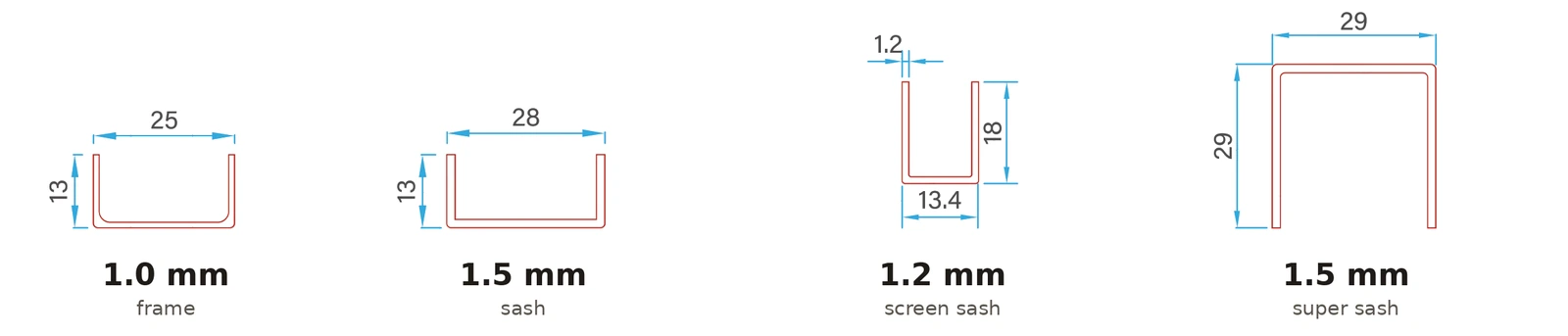
- Hardware suited to the coast. Rollers, locks, hinges and screws are the parts that meet the salt. Stainless steel and coastal-grade fittings cost a little more and last far longer.
- SS304 mesh, not aluminium mesh. Ordinary aluminium mosquito mesh corrodes in salt air within a few years. Stainless steel mesh lasts many times longer. More on mesh options in our mesh sash guide.
- Laminated or toughened glass on exposed elevations. For sea-facing windows that take the brunt of cyclonic wind, toughened or laminated glass is the safer choice. Laminated glass holds together if it breaks.
- Proper drainage in the frame. Good uPVC sliding systems have built-in drainage slots so that wind-driven rain collected in the track is channelled out, rather than over the sill.
Sliding windows remain the most practical choice for most Vizag flats. For sea-facing rooms where wind and rain are the main concern, casement windows seal tighter because the sash presses against its gaskets when closed — worth considering for the most exposed elevation.
How replacement works
You don't need to break walls or redo your interiors.
- Site visit. We inspect every window, tell you which genuinely need replacing, and measure the openings.
- Fabrication at our Pendurthi workshop takes 7–10 working days.
- Removal and installation. The old aluminium frame is taken out, the new uPVC frame is fixed into the same opening, and the gap is sealed with foam and silicone. Minor plaster touch-up at the edges may be needed. A typical flat is done in one to three days on site.
Because the windows are made a few kilometres away rather than shipped from another city, re-measurement or adjustment doesn't add weeks to the job.
Not sure which of your windows need replacing?
We check every window on site, tell you which ones can be repaired, and give you a fixed, itemised quote.
What does replacement cost in Vizag?
Our factory-direct rates start at ₹350/sq.ft for sliding windows, ₹450/sq.ft for casement, and ₹320/sq.ft for fixed windows. Coastal upgrades — higher-grade hardware, SS304 mesh, laminated glass — add to that depending on the spec.
A quick example: a 4ft × 4ft sliding window is 16 sq.ft, so it starts at around ₹5,600.
The full picture for your home depends on the number and size of windows and which elevations face the sea. We give a fixed, itemised quote after the site visit. For our full Vizag pricing and coverage, see uPVC windows in Visakhapatnam.
When to do it
The dry months from December to May are the easiest time to replace windows — no rain to work around. But if your windows are already leaking or won't close properly, don't wait for a better season. October to December is cyclone season on this coast, and a window that won't close or seal is the last thing you want when a storm warning comes in.
Book a free site visit
Not sure whether your windows need repair or replacement? WhatsApp us a few photos of the frames and tracks, and we'll give you an honest first opinion. Or book a free site visit — we'll check every window and give you a fixed, itemised quote.
We cover all of Visakhapatnam, including Rushikonda, MVP Colony, Madhurawada and Dwaraka Nagar, from our workshop in Pendurthi.
Call +91 93465 86085 · WhatsApp us
Book a free site visit
We'll check every window, tell you honestly what needs replacing, and leave you with a fixed, itemised quote. No obligation.
Replacing aluminium, answered
Yes. The old aluminium frame is removed and the new uPVC frame is fixed into the same opening, then sealed with foam and silicone. At most, minor plaster touch-up is needed around the edges. No structural work is involved.
Mason's factory-direct rates start at ₹350/sq.ft for sliding windows, ₹450/sq.ft for casement and ₹320/sq.ft for fixed windows. Coastal upgrades such as stainless steel hardware, SS304 mesh and laminated glass add to the cost depending on the specification. A free site visit gives you a fixed, itemised quote.
The uPVC profile itself does not corrode. The parts to watch on the coast are the steel reinforcement inside the frame and the hardware. Well-galvanised reinforcement and stainless or coastal-grade hardware avoid the rust problems that cheaper windows can develop.
If the frame is sound and only the rollers, handles or seals have failed, repair is often the better choice. If the frame itself is pitted or corroded, or water is coming through the frame, replacing the parts will only delay the problem.
Fabrication at our Pendurthi workshop takes 7–10 working days after the order is confirmed. Removal and installation for a typical flat takes one to three days on site.
For elevations exposed to strong wind and cyclones, toughened or laminated glass is the safer choice. Laminated glass holds together if broken. For sheltered windows, standard toughened glass is usually sufficient.