The keys are nearly yours. The Griha Pravesam date is fixed, the puja is planned, and the builder's team is waiting for a signature on the handover form. Most people walk through the flat once, look at the tiles and the paint, and sign.
The windows usually get a glance. That's worth changing, for one simple reason: anything you find before you sign is the builder's to fix, at no cost to you. Anything you find after you've moved in, hung curtains and lived through a monsoon becomes a negotiation — or your bill.
We fabricate and install uPVC windows in Hyderabad, and every year we get calls from people who moved into a new flat a year or two earlier: a door that won't slide, water on the sill, a mesh track with no mesh in it. Much of it could have been caught at handover, with half an hour and this list.
What to bring
- Your phone, for the torch and for photographs of anything wrong
- A cup or a bottle of water
- The builder's specification sheet, if you have one — it tells you what you were promised
- Half an hour, without the builder's representative hurrying you
The checklist
Go room by room and open every window and door. Every one — the small kitchen ventilator and the utility window included. A builder's snagging team checks a sample; you're checking yours.
1. Slide and swing every opening
A sliding sash should move along its full length with light pressure from one hand. It shouldn't grind, jump, catch partway, or need lifting. If it does, the cause is usually debris in the track or a roller that's damaged or out of adjustment. Both are easy to fix now, and both get worse with use.
For casement windows and doors, open each one fully. The friction stays should hold the sash wherever you leave it, rather than letting it swing shut or drift open. Close it again: it should meet the frame evenly without you having to force it.
2. Every lock, every handle
Lock and unlock each opening. On a sliding window, the lock should engage fully and the sash shouldn't rattle once it's locked. On a casement, a multi-point lock catches at several points along the frame at once — watch that they all engage.
Handles should be firm. A handle that wobbles has a loose fixing or a cracked part, and it will only get looser. If any handle has a key, make sure you've been given it.
3. Rubber gaskets and frame corners
Run your finger around the black rubber gasket where the glass meets the frame, and around each sash. It should be one continuous seal with no gaps, especially at the corners, and it shouldn't be torn, cut short or pulled out of its groove.
Then look at the corners of each frame. uPVC frames are welded at the corners, and the joint should be a clean, closed seam. A hairline crack or a gap at a corner weld is a defect, not a cosmetic mark.
Gaskets and corners are where dust and rain get in. Hyderabad's construction dust finds every gap a window leaves open, and in a building with active construction next door, you'll notice the difference within weeks.
4. The glass
Look at every pane against the light. Note scratches, chips and cracks — chipped edges especially, because a chip can become a crack.
If your windows are meant to have toughened glass, look for a small etched or printed mark in one corner of each pane; most toughened glass carries one. If the specification says toughened and a pane has no mark, ask.
If you have double-glazed units — two panes with a gap between them — check for mist or condensation between the panes. Moisture inside a sealed unit means its seal has failed, and it won't clear on its own.
5. Is there a mesh — or just a track for one?
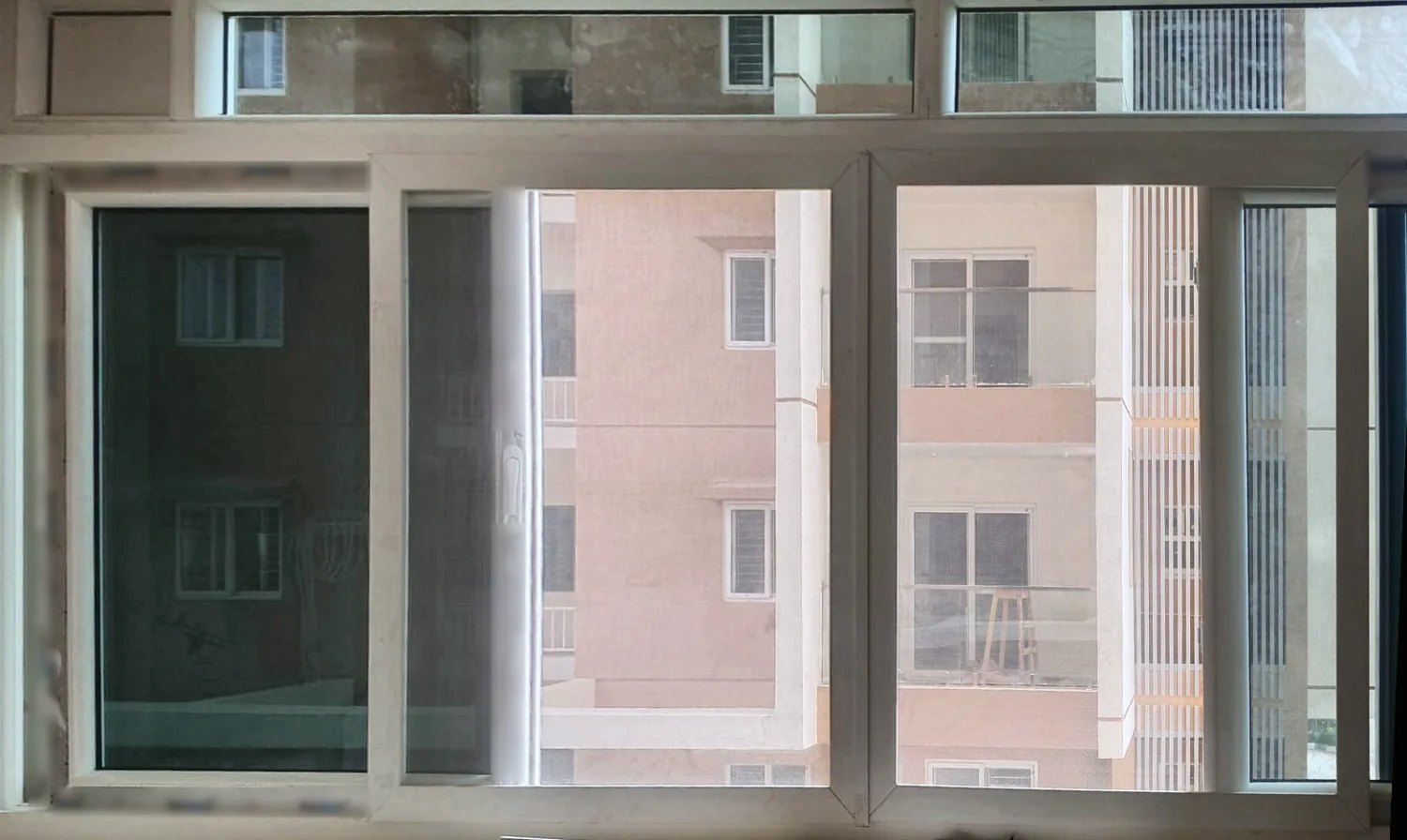
This catches more people than anything else on the list. Many builders specify 2.5-track or 3-track sliding windows, where one track exists to hold a mosquito mesh sash, and then leave the mesh sash out to save cost. The brochure says "3-track". The window has two glass panels and an empty track.
Count the tracks. If one is empty, ask whether a mesh was part of the specification. If it was, it should be fitted before handover. If it wasn't, it can be added later without replacing the window — we've explained how in adding a mesh sash to existing uPVC windows. A true 2-track window, with no spare track, can only take a fixed mesh, so it's worth knowing which kind you have.
6. Drainage — the cup-of-water test
Sliding windows and doors are designed so that rainwater collecting in the bottom track drains to the outside, through small slots in the outer face of the frame. During construction, those slots routinely get blocked with plaster, cement or grout.
Pour a little water into the outer bottom track of each sliding window. It should drain away to the outside within a minute or so. If it sits there, or comes inside, the drainage is blocked — and that window will put water on your sill in the first heavy rain.
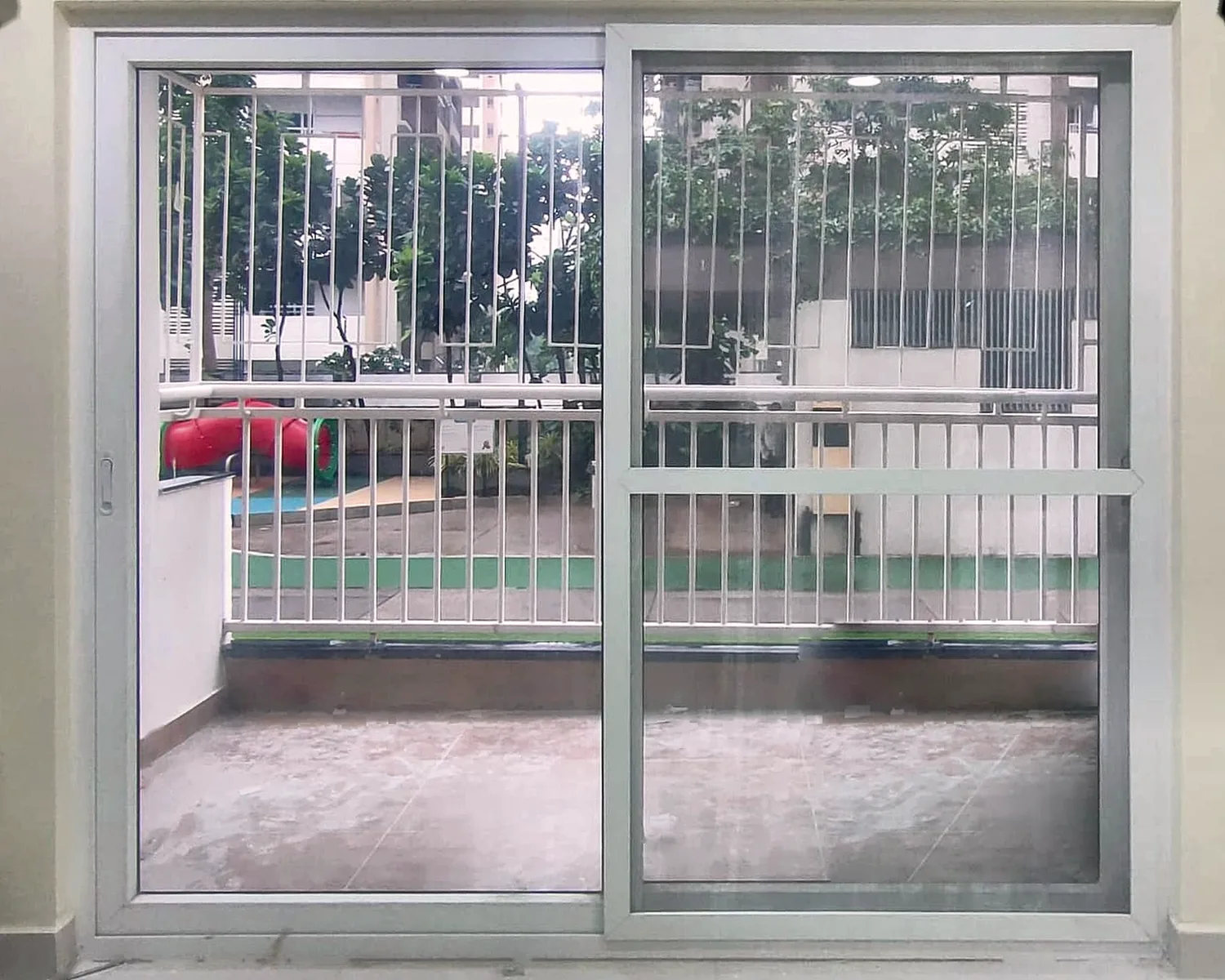
For sliding balcony doors, also check that the floor tiles and grout haven't been laid over or against the bottom track. It's a common finishing problem, and it both blocks the drainage and stops the door running smoothly.
7. The seal between the frame and the wall
Where the window frame meets the wall, there should be a continuous bead of sealant, inside and out, with no gaps or cracks. Check everything you can reach from inside. For the outside, look from the balcony, or at the lower-floor windows you can see from the ground — the same team usually fitted every flat.
Don't lean out of a high window to check. If you can't see the outside safely, note it and check after the first heavy rain instead.
8. Protective film and construction mess
New uPVC frames often arrive with a thin protective film. It's meant to come off soon after installation; left on in direct sun for months, the adhesive bakes onto the frame and becomes very hard to remove cleanly. If it's still there at handover, ask for it to be removed, or peel it off yourself the same week.
While you're looking, note any plaster, paint or cement splashed on frames, gaskets or tracks. It's easy to clean now and damaging later — cement in a track wears rollers out.
9. Ask for the paperwork
Before you sign, ask the builder three questions, and get the answers in writing:
- Who fabricated and installed the windows? That's the number you'll call in three years when a roller fails.
- Which profile system and glass were used? It should match what you were sold.
- What warranty applies, and who honours it? A window warranty is really three — on the profile, the hardware and the workmanship — often from three different parties. We've explained the difference in what changes between a cheap uPVC quote and a good one.
What to do with what you find
Write every defect on the builder's snag list, with the room and the window, and attach a photograph. Ask for a date by which each one will be fixed, and check the fixes before you sign off.
Two things worth knowing:
- Your builder's responsibility doesn't end at handover. For RERA-registered projects, the Real Estate (Regulation and Development) Act, 2016 requires the builder to fix defects in workmanship or quality that you report within five years of possession, free of charge, within 30 days. Keep your snag list and your photographs — they're your record.
- Some problems only show in the rain. No amount of checking in a dry month will reveal every leak. After the first heavy rain in your new flat, walk round again and check every sill, and the wall below every window, for damp. Report anything straight away.
What a builder won't fix — because it was never included
Not everything on this list is a defect. Some of it is simply something you weren't given:
- No mosquito mesh on a window built to take one
- An open balcony you'd rather use as a room, or seal against dust and pigeons — see our guide to balcony closing in Hyderabad
- Single glass in a road-facing bedroom, where noise matters more than the builder assumed
These are upgrades rather than repairs. They can be done after you move in, without replacing the windows or breaking walls. It's work we do across Hyderabad, including in the newer gated communities around Kokapet, Narsingi, the Financial District and Miyapur.
The short version
If you only have five minutes, check these:
- Every sash slides or swings with one hand
- Every lock engages fully
- Gaskets are continuous and corners are clean
- No scratched, chipped or misted glass
- Count the tracks — is there a mesh, or an empty track?
- Water poured into the outer track drains outside
- The sealant between frame and wall has no gaps
- The protective film has been removed
- You know who installed the windows, and what warranty you have
Found something?
If your builder fixes it, good — that's the right outcome, and it costs you nothing. If you're left with an empty mesh track, a balcony you want enclosed, or a window the builder won't deal with, we're happy to take a look.
Book a free site visit: we'll check every window, tell you honestly which problems are the builder's to fix and which are upgrades, and give you a fixed, itemised quote for anything you want done. We work across Hyderabad from our Patancheru workshop.
Call us on +91 93479 86085 or WhatsApp us.
Just got the keys?
We'll check every window and door with you, tell you what's the builder's to fix and what's an upgrade, and share a fixed, itemised quote — free, no obligation.
New flat handover, answered
Open and close every window and door, and check that each one moves smoothly and every lock engages fully. Look for gaps in the rubber gaskets, cracks at the frame corners, and scratched, chipped or misted glass. Count the tracks on sliding windows to see whether a mosquito mesh is missing, test the drainage with a little water, and check the sealant between the frame and the wall.
Pour a little water into the outer bottom track. It should drain to the outside within a minute or so, through small slots in the outer face of the frame. If the water stays in the track or comes inside, the slots are blocked — usually by plaster, cement or grout from construction.
Probably. 2.5-track and 3-track sliding windows have an extra track meant to hold a mosquito mesh sash, which builders sometimes leave out to save cost. Ask whether a mesh was in your specification. If it was, it should be fitted before handover; if it wasn't, a mesh sash can be added later without replacing the window.
For RERA-registered projects, the builder must fix defects in workmanship or quality that you report within five years of possession, free of charge, within 30 days. Record every defect on the snag list with a photograph, and keep copies.
Yes, soon after installation. Left in direct sun for months, the film's adhesive bakes onto the frame and becomes very hard to remove cleanly. If it's still on at handover, ask the builder to remove it or peel it off yourself the same week.
Yes. A mesh sash can be added to a 2.5-track or 3-track sliding window without replacing it, and a balcony can be enclosed with uPVC sliding windows. Neither needs any wall to be broken.